
 NEWS LIVE
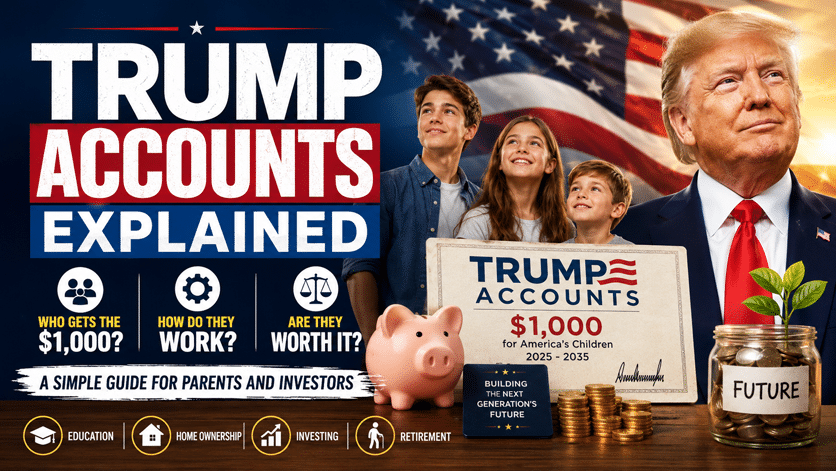
Trump Accounts Explained: Who Gets the $1,000, How They Work, and Whether They’re Worth It
Trump Accounts are one of the most talked-about child investing programs because they combine a government-funded $1,000 seed contribution, a child-focused tax-advantaged account, and a lot of confusion about who qualifies, how the account works, and whether parents should actually put their own money into it.
Quick Answer: What Parents Need to Know
Trump Accounts are tax-advantaged child investment accounts created under IRC §530A. Any eligible U.S. child under 18 can have one, but the headline benefit is the $1,000 Treasury-funded pilot contribution for U.S. citizen children born between January 1, 2025 and December 31, 2028. Parents can generally contribute up to $5,000 per year, and the account is managed by a parent or guardian until the child turns 18.
The short version is this: if your child qualifies for the $1,000 seed, opening the account may be worth doing even if you later decide that most of your long-term child savings belong in a 529 plan or a custodial brokerage account. The smarter question is not just “What is a Trump Account?” but “Should I open one, and should I add my own money after the $1,000?”
Trump Account Key Facts at a Glance
$1,000 federal seed contribution
Eligible U.S. citizen children born between Jan. 1, 2025 and Dec. 31, 2028 can receive a one-time Treasury-funded pilot contribution.
Any U.S. child under 18 can have an account
The account structure is broader than the $1,000 pilot window, which means the ability to open the account and eligibility for the seed money are not exactly the same thing.
Up to $5,000 in annual contributions
Parents can add money over time, and the account is designed as a long-term investing vehicle rather than a normal bank savings account.
Parent or guardian controls it until 18
The child is the beneficiary, but the parent or guardian acts as custodian until the child reaches age 18, when the account shifts into its next phase.
What Are Trump Accounts?
Trump Accounts are tax-advantaged child investment accounts established under IRC §530A. They’re designed to give children an early financial foothold by combining long-term investing with a government-backed starting contribution for eligible kids.
At the simplest level, a Trump Account is a child’s investment account held in the child’s name, with a parent or guardian serving as custodian while the child is a minor. The money is intended to grow over time, and the account is structured more like a long-term wealth-building tool than a basic savings account.
What makes Trump Accounts different from other child investing options is the $1,000 pilot contribution. For eligible children, the U.S. Treasury can fund the account with a one-time $1,000 deposit. That’s why the topic has exploded in search: people aren’t just asking what the account is — they want to know whether their child qualifies and whether it’s smart to open one.
Why Search Interest Around Trump Accounts Is So High
Trump Accounts sit at the intersection of family finance, government benefits, and politics, which is exactly why search demand is so strong. Most people looking this up fall into one of five buckets:
- Basic explainer intent: What is a Trump Account? How does it work? Is it a real program?
- $1,000 eligibility intent: Does my child get the $1,000? Is it only for babies born in certain years?
- Action intent: How do I open a Trump Account? What app or form do I need? Why is my activation not working?
- Comparison intent: Is a Trump Account better than a 529 plan, custodial brokerage account, or Roth IRA for kids?
- Worth-it intent: Should I just take the free $1,000 and stop there, or actually use this as a real savings strategy?
If you’re publishing on this topic, that last one matters most. A post that only explains the account will leave a lot of search value on the table. A post that helps readers decide what to do with the account will perform better.
Who Qualifies for a Trump Account?
This is the single most important section in the entire article, because there are really two different eligibility questions hiding inside the Trump Account discussion.
1) Who can have a Trump Account?
In general, a U.S. child under 18 with a Social Security number can have a Trump Account, with a parent or guardian acting as custodian until age 18.
2) Who qualifies for the $1,000 Treasury contribution?
This is narrower. The current pilot contribution applies to U.S. citizen children born between January 1, 2025 and December 31, 2028. In other words, the $1,000 is not simply available to every child who can open an account.
That distinction matters a lot. A child may be eligible to hold a Trump Account but not eligible for the one-time $1,000 seed. If you make that distinction clearly in your post, it will immediately be more useful than many of the shallow explainers ranking around this topic.
What this means in plain English
- Children born before Jan. 1, 2025: they may still be able to have a Trump Account, but they generally do not qualify for the pilot $1,000 contribution.
- Children born from Jan. 1, 2025 through Dec. 31, 2028: these are the children who matter most for the pilot funding conversation.
- Older children under 18: parents may still be able to open accounts for them, but the “free $1,000” headline may not apply.
Do Kids Really Get $1,000 in a Trump Account?
Yes — but only if they meet the current pilot eligibility rules. The $1,000 is not a universal deposit for every child in America. It’s a one-time pilot contribution from the U.S. Treasury for qualifying children in the eligible birth window.
That means the better question isn’t just “Is the $1,000 real?” It’s this:
- Does my child qualify for the pilot contribution?
- Do I need to actively elect into it?
- Do I need to file a form or activate the account first?
- Will the money show up automatically, or only after setup is complete?
That’s why the Trump Account conversation has shifted from “what is it?” to “how do I actually claim it?” A lot of current interest is about setup, activation, and funding status rather than the idea of the account itself.
How Trump Accounts Work
Trump Accounts are designed as long-term investment accounts for children. Instead of sitting in cash like a normal savings account, the funds are invested and allowed to grow over time.
Here’s the basic structure:
- A parent or guardian opens the account for a child under 18.
- The child is the account beneficiary, but the adult acts as custodian while the child is still a minor.
- Eligible children may receive the $1,000 Treasury seed contribution once the required setup and election steps are completed.
- Parents can add their own contributions up to the annual cap.
- The money is invested for long-term growth rather than left sitting idle.
- At age 18, the account transitions into its next phase and the child gains control under the account rules.
Current coverage has also highlighted that the investment menu is more limited than a full brokerage account. That’s an important point because a Trump Account is not designed to be a completely open-ended investing playground. It’s a more structured program account.
How to Open a Trump Account
This is one of the strongest practical sections to include because a lot of current search traffic is not just informational — it’s operational. Parents want to know exactly how the process works.
The current setup process typically looks like this:
- Confirm your child’s eligibility for the account and separately for the $1,000 pilot contribution.
- Complete the required election / onboarding steps, which currently revolve around IRS Form 4547.
- Use the official Trump Accounts app or supported web flow to manage activation and next steps.
- Watch for the activation email / in-app notice if additional action is required before the account can receive pilot or other contributions.
- Verify that the pilot contribution election was made correctly if your child is in the eligible birth window.
One detail worth emphasizing in your WordPress article is that account opening, pilot election, and account activation are related but not always identical steps. That’s where a lot of the current confusion is coming from.
Important practical note for parents
Some parents are currently searching because they’ve already filed the paperwork but still haven’t seen the account activate or the pilot funding appear. If you want your post to feel genuinely helpful, include a short troubleshooting section on activation delays, “unable to process” messages, and re-checking the pilot election instead of writing the article as if setup is always frictionless.
How Much Can You Contribute to a Trump Account?
The current headline rule is that parents can generally contribute up to $5,000 per year to a Trump Account. That matters because the long-term value of the account is not just about the free $1,000. It’s about what happens after that.
If you’re evaluating the account seriously, here are the practical questions to ask:
- Do I want to contribute every year, or just take the $1,000 and leave it alone?
- Is the Trump Account where I want my next $5,000 to go, or would I rather put that money in a 529 plan?
- Can grandparents, employers, or outside donors contribute too?
- Would I rather keep my child’s long-term savings in a more flexible brokerage structure?
These questions matter because a Trump Account may be a good first account for a qualifying child without necessarily being the best destination for every future contribution.
Are Trump Accounts Tax Deductible?
This is one of the most important money questions around the program because many parents hear “tax-advantaged” and immediately assume “tax deduction.” That’s not the same thing.
Trump Accounts are generally discussed as tax-advantaged / tax-deferred child investment accounts, but that does not mean your personal contributions are automatically tax-deductible.
For a parent, the practical takeaway is simple:
- Don’t assume you get an immediate tax break just because you add money to the account.
- The main attraction is more about long-term growth and structured tax treatment than about a same-year deduction.
- If your main goal is a very specific tax outcome, compare the Trump Account with a 529 plan and with your state-level education savings options before deciding where to put ongoing contributions.
What Happens to a Trump Account at Age 18?
This is one of the biggest unanswered questions for readers, and it’s exactly the kind of section that can help your article outrank thinner explainers.
The broad framework is that the parent or guardian acts as custodian until the child turns 18. At that point, the child takes control and the account moves into its next rules phase. Current government and financial coverage describes Trump Accounts as operating under a special child-focused structure before 18 and then aligning more closely with traditional IRA-style treatment after that age.
For a parent, the real question is not just “Who controls it at 18?” but also:
- Can the child withdraw money immediately?
- Are there tax consequences if they do?
- Is the money better left invested beyond age 18?
- Does it still make sense if the child doesn’t need the money for education right away?
That’s one reason many parents will still compare Trump Accounts with 529 plans and brokerage accounts. The best child savings account is not just about getting money into the account — it’s about what the money can do later.
Trump Account vs 529 Plan
For most families, this is the comparison that matters most. A 529 plan is still one of the strongest child savings tools if your main goal is paying for college or other qualified education expenses. A Trump Account is more interesting when the child qualifies for the $1,000 Treasury seed and you want a child-focused investment account that isn’t defined solely by education spending.
| Feature | Trump Account | 529 Plan |
|---|---|---|
| Main purpose | Long-term child investing / wealth-building | Education savings |
| Government seed contribution | Yes, for eligible children in the pilot window | No |
| Best use case | Families who qualify for the $1,000 and want an extra child investing vehicle | Families whose main priority is college or education funding |
| Contribution appeal | Useful if you want to capture the seed and continue long-term investing | Strong if you want education-specific tax benefits |
| Main caution | May not be the best destination for every future child savings dollar | Less flexible if the money won’t be used for education |
The smartest answer for many families may not be “Trump Account or 529.” It may be “Trump Account and 529, but for different jobs.” For example, you might open a Trump Account to claim the $1,000 seed, but still direct most future education savings into a 529 plan.
Trump Account vs Custodial Brokerage Account
A custodial brokerage account is often the strongest alternative for families who care more about flexibility than about program-specific benefits. It won’t come with a Treasury-funded $1,000 seed, but it can offer broader investment choice and fewer program-specific restrictions.
| Feature | Trump Account | Custodial Brokerage |
|---|---|---|
| Free government seed | Possible for eligible children | No |
| Investment flexibility | More limited program structure | Usually broader investment flexibility |
| Best for | Families who want the pilot benefit and a structured child account | Families who want maximum flexibility and wider control over the portfolio |
| Main trade-off | More structure, but a potentially valuable starting benefit | More freedom, but no $1,000 head start |
Trump Account vs Roth IRA for Kids
A Roth IRA for kids is one of the best long-term wealth-building accounts available, but it comes with one major limitation: the child must have earned income. That makes it a poor substitute for a Trump Account when the child is a baby or very young.
So while these accounts sometimes get compared, they aren’t really competing for the same moment in a child’s life. A Trump Account is more relevant at birth or during childhood. A Roth IRA becomes relevant later when the child is working and legally eligible to contribute earned money.
Should You Open a Trump Account Just for the Free $1,000?
For many eligible families, the answer may be yes.
If your child qualifies for the pilot contribution, opening the account just to capture the $1,000 can make sense even if you never treat the account as your primary child savings vehicle. Free seed money invested early has decades to compound, and there may be no reason to walk away from it if the setup is manageable.
But the second question is more important: Should you add your own money after that? That’s where the answer becomes personal.
- If your goal is college funding, a 529 may still be the stronger destination for most future contributions.
- If your goal is maximum flexibility, a custodial brokerage account may be better.
- If your goal is capturing the $1,000 and building a parallel child investment account, the Trump Account can be a useful piece of the puzzle.
My strategic take for the structure of this article: frame the Trump Account as a “claim the seed, then compare the next dollar” decision. That is a much more useful and search-friendly way to guide parents than treating the program like an all-or-nothing choice.
What Parents Are Worried About Right Now
This is one of the most valuable sections you can include because it reflects the actual friction points people are searching and discussing instead of just the official marketing language.
1) “My child qualifies — but should I actually add my own money?”
Many parents are comfortable claiming the $1,000 but hesitant to treat the account as their main child savings vehicle until they understand the long-term restrictions and trade-offs.
2) “Why is my Trump Account activation delayed?”
Current discussion already includes questions about activation emails, Form 4547 processing, “unable to process” notices, and timing gaps between election and funding. If you include a short troubleshooting section, your post becomes immediately more useful.
3) “Is this better than just using a 529?”
For parents focused on college, this is often the real decision. Trump Accounts are interesting because of the $1,000 seed. But that doesn’t automatically make them the best home for every future contribution.
4) “What if my older child doesn’t qualify for the free money?”
This is a common emotional and practical concern. Families with multiple children may have one child eligible for the pilot seed and another who isn’t. That doesn’t make the account useless for the older child, but it changes the math and the motivation.
Trump Account Pros and Cons
Pros
- The $1,000 seed contribution is a real financial head start for eligible children.
- Starting early matters. Even modest money invested at birth or in early childhood can compound meaningfully over time.
- The account can encourage parents to begin investing for a child earlier than they otherwise would.
- It may work well as a supplemental child account alongside a 529 or other savings vehicle.
Cons
- The rules are more nuanced than the headline. Being able to open the account is not the same as qualifying for the $1,000.
- It may not be the best primary savings vehicle for families focused specifically on education.
- The account appears more structured and less flexible than a normal custodial brokerage account.
- Setup, election, and activation details matter, which can make the user experience feel more complicated than a simple bank or brokerage account.
Are Trump Accounts Worth It?
For a lot of families, the answer is yes — at least enough to open the account if the child qualifies for the $1,000. That’s the cleanest, most defensible case for the program.
Where it becomes more nuanced is in deciding whether the Trump Account should be your main child savings vehicle or just one part of a broader strategy.
A Trump Account may be worth it if:
- your child qualifies for the $1,000 seed contribution
- you want a dedicated long-term child investing account
- you’re comfortable using it as an additional savings layer rather than your only plan
You may want to be more cautious if:
- your primary goal is saving specifically for college and a 529 plan fits better
- you strongly prefer broad investment flexibility
- you’re not comfortable contributing more money until you fully understand the withdrawal and age-18 implications
Bottom line
If your child qualifies for the Treasury-funded $1,000, opening a Trump Account may be a smart move. But whether you should contribute much more than that depends on what you want the money to do — pay for education, stay flexible, or simply grow as an additional long-term asset for your child.
Best Subtopics to Cover in the Same Post or as Supporting Articles
If you want to build topical authority around this keyword, these are the best related subtopics to target next.
What to Include in Your WordPress Post That Most Articles Miss
If you want your post to be stronger than the typical finance explainer, include these sections explicitly:
- A top answer box that states who gets the $1,000, who doesn’t, and whether the account is worth opening.
- A “Should I open one just for the free $1,000?” section because that’s one of the strongest real-world reader questions.
- A troubleshooting section for activation delays, pilot election confusion, and account setup friction.
- A comparison table against 529 plans and custodial brokerage accounts.
- A section for families with multiple kids, especially where one child qualifies for the pilot and another doesn’t.
- A “What happens at age 18?” section because readers care about the exit and control rules, not just the deposit.
That combination turns the article from a basic explainer into a genuine decision guide, which is exactly how you make it more competitive.
Frequently Asked Questions About Trump Accounts
What is a Trump Account?
A Trump Account is a tax-advantaged child investment account created under IRC §530A. It’s designed to help children build long-term savings, and eligible children in the current pilot window may receive a one-time $1,000 Treasury contribution.
Do all children get $1,000 in a Trump Account?
No. The $1,000 pilot contribution applies to eligible U.S. citizen children born between January 1, 2025 and December 31, 2028. Being able to open the account is not the same as qualifying for the pilot seed contribution.
Can older children still have a Trump Account?
Yes, the account structure is broader than the pilot funding window. A child may still be able to have a Trump Account even if they don’t qualify for the one-time $1,000 Treasury contribution.
How much can parents contribute to a Trump Account?
The current headline contribution cap is up to $5,000 per year, which means parents can choose to build on the initial Treasury seed if they want to use the account as a longer-term child savings tool.
Are Trump Accounts tax deductible?
Parents should not assume that personal contributions are automatically tax-deductible. Trump Accounts are generally described as tax-advantaged or tax-deferred, but that does not automatically mean an immediate deduction for your contribution.
Is a Trump Account better than a 529 plan?
Not necessarily. A Trump Account may be attractive if your child qualifies for the $1,000 seed, while a 529 plan may still be better for families whose primary goal is saving specifically for education.
Should I open a Trump Account just for the free $1,000?
For many eligible families, yes. Claiming the $1,000 seed may make sense even if you later decide that most of your child’s long-term savings should go elsewhere. The more important follow-up question is whether you want to keep contributing after that.
What happens to the Trump Account when the child turns 18?
The parent or guardian serves as custodian until age 18. After that, the child takes control and the account moves into its next rules phase, which is why it’s important to understand how access, withdrawals, and long-term use work before treating the account as your main child savings vehicle.
Final Verdict
Trump Accounts are worth paying attention to because they create a real decision point for parents. If your child qualifies for the $1,000 Treasury contribution, opening the account may be one of the easiest long-term financial wins available. But that doesn’t automatically mean every future child savings dollar belongs there.
The strongest way to think about Trump Accounts is this: claim the seed if you qualify, then compare the next dollar carefully. For some families, the next dollar belongs in a Trump Account. For others, it belongs in a 529 plan or a custodial brokerage account. The right answer depends on whether your priority is education, flexibility, or simply building another long-term asset in your child’s name.
Source and accuracy note
This article is written as a practical parent-focused explainer and will be updated as official implementation details evolve.
Publishing Notes for This Topic
Primary keyword: Trump Accounts
Secondary keywords to weave naturally into the post: Trump Account $1000, Trump Account eligibility, how to open a Trump Account, Trump Account app, Trump Account vs 529, are Trump Accounts tax deductible, what happens to a Trump Account at 18.
Slug: /trump-accounts/
Title: Trump Accounts Explained: Who Gets the $1,000, How They Work, and Whether They’re Worth It
Description: Trump Accounts could give eligible children a $1,000 government-funded head start. Here’s who qualifies, how Trump Accounts work, how to open one, contribution rules, tax basics, and whether they’re better than a 529 plan.